Painting over an epoxy floor coating is possible – but only if you understand why epoxy resists paint and prepare the surface correctly. Most failures (peeling, bubbling, poor adhesion) happen because epoxy cures into a hard, non‑porous surface that standard paints can’t grip.
If you’re considering painting an existing epoxy floor to change color, refresh a worn surface, or avoid full removal, this guide walks you through when it works, when it doesn’t, and what professionals do differently.
Quick Answer
Yes, you can paint over an epoxy floor coating if:
- The epoxy is fully cured and structurally sound
- The surface is properly cleaned and mechanically profiled (sanded)
- You use a compatible primer and floor-grade coating
And no, you shouldn’t paint over epoxy if the floor is peeling, delaminating, moisture-damaged, or glossy without proper surface prep.
Why This Question Matters
Epoxy floors are designed to be permanent, chemical‑resistant, and smooth. That durability is exactly what makes repainting risky. Unlike bare concrete, epoxy doesn’t absorb paint-so adhesion depends entirely on surface preparation and coating selection.
Understanding this upfront saves time, money, and failed DIY attempts.
Why Paint Doesn’t Bond to Epoxy
Epoxy floor coatings cure into a dense, cross‑linked plastic surface. Once cured, the surface is:
- Non‑porous (paint cannot soak in)
- Chemically resistant (most paints can’t etch it)
- Smooth or glossy (low surface profile = poor mechanical grip)
Paint sticks to concrete by absorption and micro‑texture. Epoxy offers neither. Without surface profiling, paint sits on the epoxy instead of bonding to it-leading to peeling under foot traffic, hot tires, or moisture vapor pressure.
The Only Two Ways Paint Can Adhere to Epoxy
- Mechanical bond – created by sanding or grinding to roughen the surface
- Chemical compatibility – using primers or coatings designed to bond to cured epoxy
If neither is achieved, failure is expected – not possible, but likely.
Why “Just Cleaning” Is Not Enough
Degreasers and acid washes remove contaminants, not surface hardness. They do not open epoxy pores or create profile. A clean but glossy epoxy floor is still a non‑bondable surface.
Bottom line: adhesion is a surface‑profile problem, not a cleanliness problem.
When Painting Over Epoxy Makes Sense (And When It Doesn’t)
Painting over epoxy is a situational fix, not a universal solution. The decision depends on surface condition, usage, and expectations.
Painting Over Epoxy Does Make Sense If:
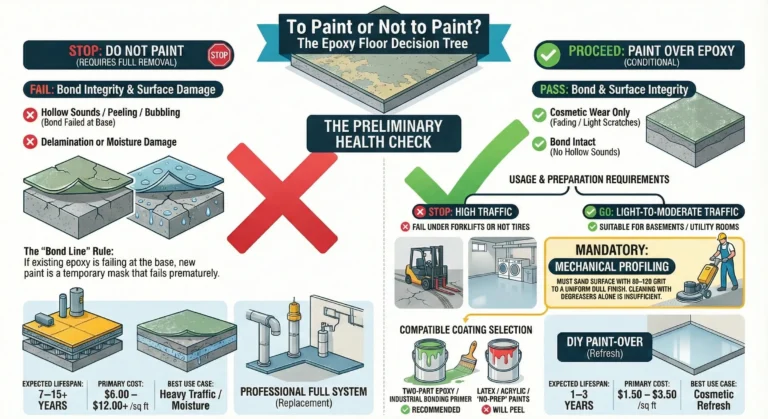
- The epoxy is fully cured and firmly bonded to concrete
- There is no peeling, flaking, or hollow-sounding delamination
- The surface shows cosmetic wear only (fading, light scratches)
- The area has light to moderate traffic (basements, utility rooms)
- You want a color change or short‑ to mid‑term refresh
In these cases, proper mechanical profiling + primer can deliver acceptable performance.
Painting Over Epoxy Does Not Make Sense If:
- The epoxy is lifting, bubbling, or separating from concrete
- Moisture vapor transmission is present
- The floor sees hot tire pickup, forklifts, or heavy abrasion
- The existing coating is high‑build, glossy, or contaminated
- Long‑term durability is required
Painting over these conditions masks problems instead of fixing them.
Better Alternatives in Failure Scenarios
- Mechanical removal + new epoxy or polyaspartic system
- Professional recoat with compatible industrial coatings
- Moisture mitigation before any new coating
Decision rule: If the existing epoxy is failing at the bond line, paint will fail faster.
Not sure which option fits your floor?
Surface Preparation That Actually Works (Step-by-Step)
Surface preparation determines success. Skipping or shortening any step below directly increases failure risk.
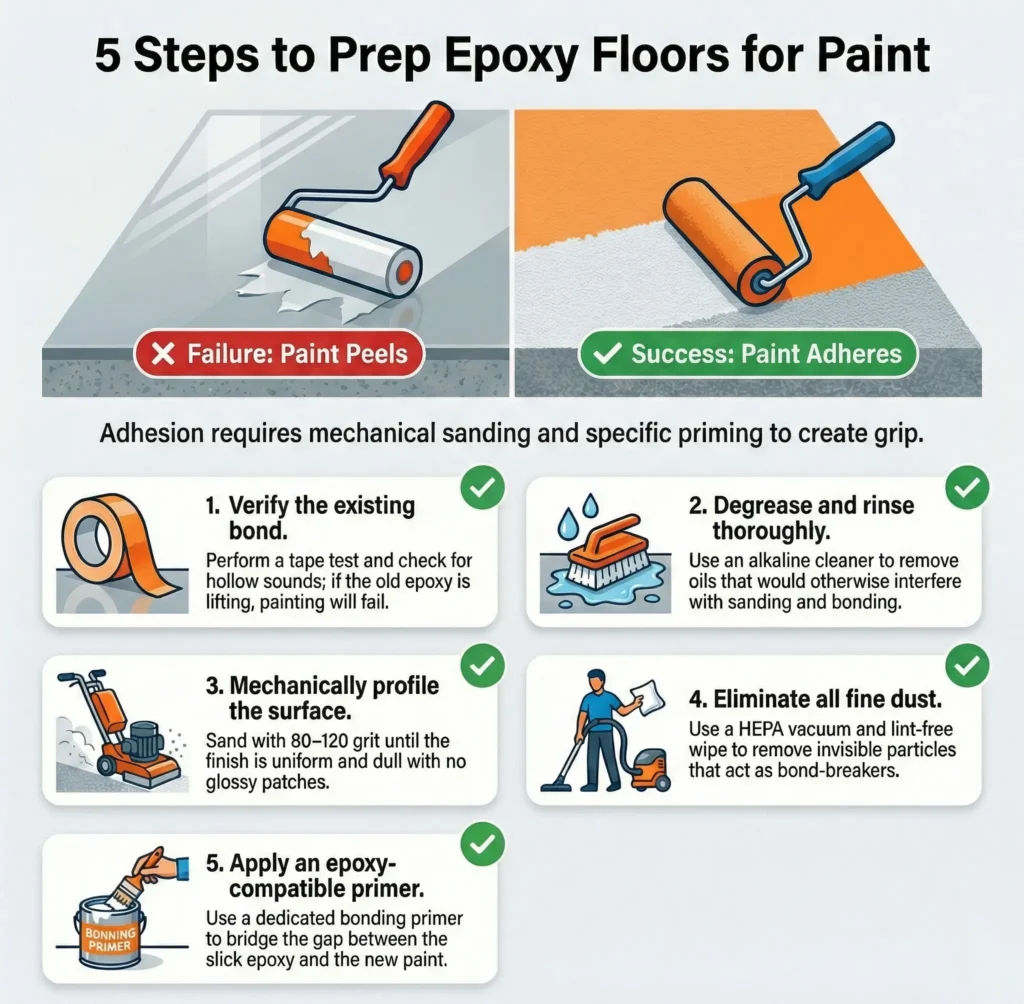
Step 1: Verify the Epoxy Is Fully Cured and Bonded
- Minimum cure time: 7 days (longer in cool or humid conditions)
- Perform a tape test in multiple areas
- Tap with a metal object; hollow sounds indicate delamination
If the coating lifts or sounds hollow, stop. Painting will not correct bond failure.
Step 2: Remove Contaminants Completely
- Degrease using a concrete-safe alkaline cleaner
- Rinse thoroughly; no residue allowed
- Allow full drying before abrasion
Contaminants interfere with sanding efficiency and primer bonding.
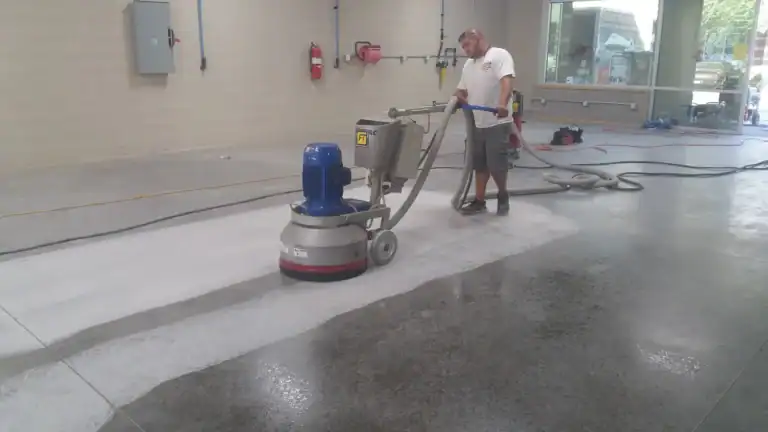
Step 3: Mechanically Profile the Surface
This is non-negotiable.
- Sand using 80–120 grit for most floor paints
- Target a uniform, dull finish (no gloss patches)
- For large areas, diamond grinding is more consistent than hand sanding
The goal is texture, not material removal.
Step 4: Remove Dust and Fine Particles
- Vacuum using HEPA or fine-dust filtration
- Follow with a lint-free wipe
Dust left behind becomes a bond-breaker under primer.
Step 5: Apply a Compatible Primer
- Use primers labeled epoxy-compatible or multi-surface bonding
- Follow manufacturer spread rates and recoat windows
Primers bridge the gap between epoxy and paint. Skipping primer is a common failure point.
Step 6: Reinspect Before Painting
- Surface should feel slightly textured, not slick
- No visible dust, grease, or glossy areas
If the surface fails inspection, correct it before moving forward.
Coatings That Can Bond to Existing Epoxy (And Those That Don’t)
Not all floor paints are suitable over epoxy. Selection should be based on adhesion mechanism, traffic level, and cure chemistry – not label claims.
Coatings That Work (When Properly Prepped)
Two-part epoxy floor paint
- Best mechanical and chemical compatibility
- Requires sanding + epoxy-compatible primer
- Suitable for moderate to heavy traffic
Polyurethane / polyurea topcoats
- Good abrasion and UV resistance
- Must be rated for application over cured epoxy
- Often used as a wear layer, not a base coat
Industrial bonding primers + floor coatings
- Designed to bridge non-porous surfaces
- Performance depends on strict recoat windows
Coatings That Commonly Fail Over Epoxy
Latex or acrylic wall paint
- Poor adhesion and low abrasion resistance
Single-part concrete paint
- Relies on concrete porosity, which epoxy lacks
“No-prep” floor paints
- Marketing-driven, not adhesion-driven
Practical Selection Rule
If the coating does not explicitly state compatibility with cured epoxy, assume it will fail.
Common Failure Modes After Painting (And Why They Happen)
Most painted‑over epoxy floors fail for predictable reasons. Identifying the cause matters more than repainting.
Peeling or Flaking Paint
Why it happens:
- Inadequate surface profiling
- Primer skipped or incompatible
- Glossy epoxy left intact
What it means: The paint never bonded mechanically. Repainting without re‑profiling will fail again.
Bubbling or Blistering
Why it happens:
- Moisture vapor pressure from the slab
- Painting over epoxy that was not fully cured
- Trapped solvents due to poor ventilation
What it means: This is a substrate or moisture issue, not a paint-quality issue.
Premature Wear or Scuffing
Why it happens:
- Wrong coating type for traffic level
- Thin application or incorrect spread rate
- No topcoat in higher-use areas
What it means: The coating system is under-specified for the environment.
Uneven Finish or Patchy Appearance
Why it happens:
- Inconsistent sanding
- Dust contamination
- Missed recoat windows
What it means: Surface prep or application control failed, not adhesion chemistry.
Key takeaway: If paint fails within months, the issue is almost always surface condition or environment, not the paint brand.
Cost and Time: DIY vs Professional
Numbers matter when deciding whether painting over epoxy is worth it.
DIY Painting Over Epoxy
- Materials: $1.50–$3.50 per sq ft (cleaners, abrasives, primer, coating)
- Prep time: 4–8 hours per 400 sq ft (cleaning + sanding)
- Application time: 2–4 hours
- Cure before light use: 24–48 hours (varies by product)
- Expected lifespan: 1–3 years in light-use areas
DIY costs are lower upfront, but failure risk is higher if prep or product selection is wrong.
Professional Recoat or Replacement Costs
- Professional repaint over epoxy: $4–$7 per sq ft
- Full removal + new epoxy or polyaspartic system: $6–$12+ per sq ft
- Downtime: 1–3 days depending on system
- Expected lifespan: 7–15+ years with proper system selection
Professional systems cost more initially but deliver longer service life and lower long-term risk.
Cost Decision Rule
If the space sees vehicle traffic, equipment loads, or moisture exposure, repainting over epoxy is rarely cost-effective long term.
Compare repainting vs professional epoxy recoating for your space.
Final Recommendation
Painting over epoxy floor coating is not a shortcut-it is a conditional solution. It works only when the existing epoxy is sound, properly profiled, and paired with compatible primers and coatings.
If the epoxy bond has failed, moisture is present, or the floor sees heavy traffic, repainting is a temporary fix at best. In those cases, recoating with a professional epoxy or polyaspartic system delivers better durability and lower long-term cost.
Bottom line: If you can’t mechanically profile it or verify bond integrity, don’t paint it.
Get a durable epoxy or polyaspartic floor installed by First Class Coatings.
FAQs: Painting Over Epoxy Floors
-
Can you paint directly over epoxy?
No. Paint will not adhere reliably to epoxy without sanding and a compatible primer. Direct application almost always leads to peeling.
-
Can you paint over epoxy resin without sanding?
No. Epoxy is non-porous. Without mechanical profiling, paint has nothing to grip.
-
Will primer stick to epoxy resin?
Only primers specifically rated for cured epoxy or non-porous surfaces will bond. Standard primers will fail.
-
How do you paint on top of epoxy resin?
Clean, sand to a dull finish, remove dust, apply an epoxy-compatible primer, then apply a floor-grade coating within recoat windows.
-
How do you prep epoxy for paint?
Degrease, mechanically sand (80–120 grit), vacuum dust, and prime. Cleaning alone is insufficient.
-
What kind of paint will stick to epoxy?
Two-part epoxy paints, polyurethane systems, or coatings designed to bond to cured epoxy.
-
Will acrylic paint adhere to epoxy?
No. Acrylic and latex paints lack the adhesion and abrasion resistance required for epoxy surfaces.
-
Do you need to sand epoxy before painting?
Yes. Sanding is mandatory to create a mechanical bond.
-
What will not stick to epoxy resin?
Latex paint, acrylic wall paint, single-part concrete paint, and any coating not rated for non-porous surfaces.